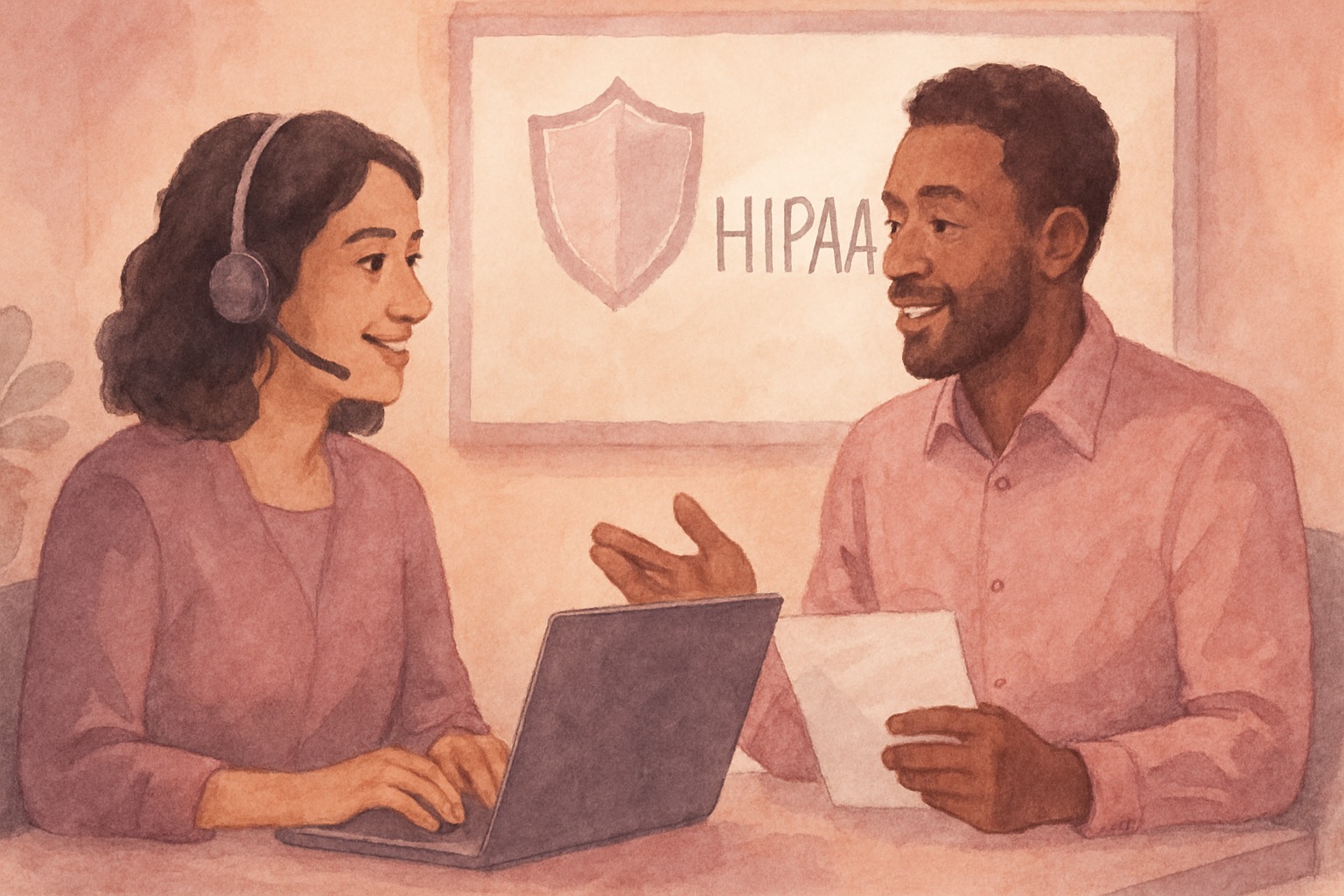
In 1996, Congress passed the Health Insurance Portability and Accountability Act. The law was primarily about insurance coverage, but buried inside it was a set of data security requirements that would reshape how an entire industry handles sensitive information.
Healthcare didn't want these rules. Hospitals, clinics, and insurers fought them. Implementation was expensive, disruptive, and slow. It took years for the industry to comply, and the early results were ugly: fines, breaches, and public embarrassment for organizations that treated the requirements as paperwork rather than practice.
But something happened along the way. The organizations that actually internalized HIPAA's principles, not just its checkbox requirements, built security cultures that turned out to be genuinely effective. They weren't just compliant. They were secure. And the gap between those two things is exactly what every company deploying AI agents needs to understand.
The Accidental Blueprint
HIPAA was written before voice AI existed, before large language models, before anyone imagined that an automated system would conduct millions of sensitive conversations per day. Yet the security framework it mandated addresses almost every vulnerability that AI deployments create.
This isn't a coincidence. HIPAA was designed around a simple insight: when systems handle sensitive data at scale, security failures are inevitable unless the architecture is built to prevent them. The specific technology doesn't matter. What matters is the framework for handling data, controlling access, and detecting problems.
The framework has three layers, and each one maps directly to what AI agent deployments require.
Administrative Safeguards: Who Owns Security?
The first thing HIPAA requires is that someone is responsible. Not a committee. Not a shared responsibility across teams. A specific person who owns security outcomes and answers for failures.
This sounds obvious. In practice, most companies deploying AI agents have no clear security owner. The engineering team assumes security is DevOps' job. DevOps assumes it's the security team's job. The security team, if one exists, is focused on network perimeter defense and hasn't been briefed on what the AI agents actually do.
HIPAA's administrative safeguards go further than just naming an owner. They require documented policies (what data can the AI access? who can read conversation logs? how long are transcripts retained?), workforce training (every person who touches AI data understands the rules), and incident response procedures (what happens when something goes wrong, rehearsed before it does).
The administrative layer is where most companies cut corners. It's also where most breaches start. A developer with too much access. A policy that was written but never enforced. An incident response plan that exists in a Google Doc nobody has read.
Technical Safeguards: How Is Data Protected?
The technical layer is where most engineering teams feel comfortable, and where they tend to over-invest relative to the administrative and monitoring layers.
HIPAA's technical safeguards cover four areas that map directly to AI agent security:
Access control. Every team member sees only the data their role requires. This means role-based access control on conversation logs, AI configurations, customer data, and analytics dashboards. Combined with multi-factor authentication, it prevents the most common breach vector: an employee account with too much privilege.
Encryption. Data encrypted at rest (AES-256 minimum) and in transit (TLS 1.3). For AI agents, this means conversation transcripts, customer context, memory stores, and any data the agent accesses during interactions. Encryption is table stakes, but it's remarkable how many AI deployments still transmit conversation data in plaintext between services.
Integrity controls. Data cannot be modified without authorization and a record of the change. For AI agents, this means configuration changes, prompt modifications, and tool access permissions are all logged and versioned.
Audit logging. Every data access event, every AI decision, every configuration change is recorded in tamper-evident logs. This is the foundation of demonstrating compliance to regulators and the first thing investigators request after an incident.
The Minimum Necessary Standard: The Most Underrated Principle
Of everything in HIPAA, the minimum necessary standard is the principle most applicable to AI agent deployments, and the one most frequently ignored.
The rule is simple: collect only the data the AI actually needs to do its job. Use it only for the stated purpose. Restrict who can view it. Delete it when you're done.
Applied to AI agents, this means asking hard questions that most teams skip:
Does the AI agent need to retain full conversation transcripts, or just the resolution outcome? If transcripts are retained, who can access them, and for how long? When a customer asks to be forgotten, can the system actually comply? Is the AI collecting behavioral signals (tone, sentiment, hesitation patterns) that aren't necessary for the task at hand?
The minimum necessary standard forces you to design data handling intentionally rather than defaulting to "keep everything forever." That default is how companies end up with massive stores of sensitive data they forgot they had, protected by security measures they forgot to update.
Why This Framework Fits AI Agents Perfectly
AI agents create security challenges that didn't exist when most organizations built their security programs. HIPAA's framework, designed for a different era of technology, happens to address them because it was built around principles rather than specific technologies.
Conversation Data Is Customer Data
Every conversation an AI agent has contains customer data. Account numbers. Personal details. Purchase history. Health concerns. Financial information. The specific sensitivity depends on the industry, but the principle is universal: conversation transcripts are not log files. They are customer data and must be handled accordingly.
This distinction matters because most AI platforms treat transcripts as operational data, stored in the same databases as system logs, accessible to anyone with a developer account, retained indefinitely. HIPAA-grade thinking says: classify this data by sensitivity, restrict access by role, encrypt it at rest and in transit, and delete it on a defined schedule.
Context Windows Are Security Perimeters
AI agents maintain context between conversation turns. That context may include sensitive details the customer shared earlier in the interaction: a Social Security number, a medical condition, a financial balance. The context window is a security perimeter, and it needs to be treated as one.
This means controlling what enters the context (does the agent need the customer's full account history, or just the relevant transaction?), what persists between sessions (should yesterday's conversation context still be accessible today?), and what gets logged (should the full context be written to audit logs, or just a sanitized summary?).
Memory Creates Long-Term Exposure
AI agents with persistent memory create a new category of security risk. Unlike a conversation that ends when the call disconnects, memory persists across interactions. A customer's preferences, history, and behavioral patterns accumulate over time in a data store that requires its own access controls, retention policies, and deletion capabilities.
HIPAA's individual rights provisions (the right to access your data, correct it, and request deletion) apply directly here. Customers should be able to ask what the AI remembers about them and request that memory be cleared. Most AI platforms have no mechanism for this.
Building the Framework: What to Actually Do
The implementation isn't complicated. It's thorough, which is different. Here's the practical sequence, drawn from what healthcare learned the hard way.
Phase 1: Map Your Data (Weeks 1-4)
Before you can secure data, you need to know where it is. Trace every piece of sensitive data through your AI system: where it enters, where it's stored, who can access it, how long it persists, and how it's deleted.
Most teams discover surprises during this exercise. Conversation transcripts stored in three different systems with different access controls. Customer data cached in a service that nobody realized was persisting it. Developer environments with production data that should have been sanitized months ago.
The map is the foundation. Everything else builds on it.
Phase 2: Classify and Restrict (Weeks 5-8)
Assign sensitivity levels to every data type flowing through your AI agents. Define handling rules for each level: who can store it, who can access it, how long it can be retained, and what encryption standard applies.
Then implement restrictions. Role-based access control on every system that touches AI interaction data. Multi-factor authentication on every account. Automatic session timeouts. Quarterly access reviews that actually revoke unnecessary permissions.
The most common implementation failure is building access controls but never auditing them. Permissions accumulate. People change roles. Access that was appropriate six months ago isn't appropriate now. HIPAA requires regular reviews for this reason.
Phase 3: Monitor and Detect (Weeks 9-16)
Real-time monitoring is what separates a compliance posture from compliance theater. You need to detect anomalies as they happen, not discover them in a quarterly audit.
This means alerting on unusual access patterns (a developer account querying thousands of conversation records at 3 AM), flagging prompt injection attempts, monitoring for data exfiltration patterns, and maintaining dashboards that security staff actually watch.
Analytics capabilities that track every interaction, score quality, and surface anomalies are not just operational tools. They are security tools. The same infrastructure that tells you whether your AI agent is performing well also tells you whether something is wrong.
Phase 4: Test and Rehearse (Weeks 17-24)
Write incident response playbooks before you need them. Then rehearse them. Healthcare learned that the organizations with untested response plans performed almost as badly during incidents as organizations with no plans at all. The difference between a written plan and a rehearsed plan is enormous under pressure.
Run tabletop exercises. What happens if a customer's conversation data is exposed? What happens if a prompt injection attack succeeds? What happens if an employee exports conversation logs they shouldn't have access to? Walk through each scenario step by step, identify gaps, and fix them before they matter.
Use scenario testing to validate that your AI agents handle security-sensitive situations correctly: customers sharing sensitive data the agent shouldn't store, requests for data deletion, attempts to extract information about other customers. These are the edge cases that standard functional testing misses entirely.
The Principles That Transfer to Every Industry
Healthcare's security framework works because it's built on principles, not regulations. Those principles apply anywhere AI agents handle sensitive data.
Financial services. AI agents handling banking inquiries, loan applications, and fraud investigations deal with data that's regulated under different laws (SOX, PCI-DSS, state financial regulations) but requires the same protections. Access control, encryption, audit logging, and data minimization are just as critical for a conversation about a checking account as for a conversation about a medical condition.
E-commerce. Purchase history, payment data, and customer service interactions are sensitive data. An AI agent that handles returns, billing disputes, and account modifications needs the same security architecture as one handling health records: controlled access, encrypted storage, defined retention, and tamper-evident logs.
Telecommunications. Call recordings, service records, and account details flowing through AI agent interactions are regulated under various privacy laws and create significant exposure if mishandled. The monitoring and audit capabilities that HIPAA requires are directly applicable.
Legal and professional services. Attorney-client privilege, financial advisory records, and consulting engagement details are among the most sensitive categories of data that AI agents might encounter. The minimum necessary standard is especially critical here.
The pattern is consistent: wherever AI agents interact with customers, they handle sensitive data. The specific regulations differ by industry, but the security principles are the same.
The Competitive Case for Security
Security is expensive. Building HIPAA-grade protections into an AI deployment costs more than building no protections at all. This is true, and it's also the wrong frame.
The correct comparison isn't security investment versus no investment. It's proactive security investment versus reactive breach costs. And the math on that comparison is not close.
Regulatory fines for data breaches involving customer interaction data are increasing across every industry, not just healthcare. The EU's GDPR, California's CCPA, and a growing patchwork of state and international privacy laws all impose penalties for inadequate data protection. A single significant breach can cost more than years of proactive security investment.
Beyond fines, there's customer trust. In enterprise sales, security questionnaires are deal-blockers. Companies that can demonstrate HIPAA-grade security practices, complete with audit trails and documented policies, close deals that security-light competitors cannot. This is increasingly true as procurement departments add AI-specific questions to their security assessments.
And then there's insurance. Cyber insurance premiums are directly tied to security posture. Companies with comprehensive, documented security frameworks pay less, sometimes significantly less, than companies with ad-hoc approaches.
The organizations that treat security as a cost center are measuring the wrong thing. The ones that treat it as infrastructure, as a competitive advantage, as a condition of doing business, tend to be the ones still in business five years from now.
What Healthcare Got Wrong (And What You Can Skip)
Healthcare's journey to security maturity wasn't efficient. It was expensive, slow, and littered with mistakes that other industries can avoid.
The biggest mistake was treating compliance as the goal rather than security. Organizations that focused on checking HIPAA's boxes, documenting policies that nobody read, running audits that produced reports nobody acted on, achieved compliance without achieving security. They passed audits and then got breached.
The second mistake was over-investing in perimeter defense and under-investing in monitoring. Firewalls and access controls are necessary but not sufficient. The breaches that cause the most damage are often insider threats or compromised credentials, problems that perimeter defense doesn't catch but real-time monitoring does.
The third mistake was failing to update. Security frameworks that are built once and never revised become progressively less effective as threats evolve. HIPAA itself has been updated multiple times, and the organizations that treat their security posture as a living system rather than a completed project are consistently more secure.
You can learn from these mistakes without repeating them. Start with monitoring as a first-class concern, not an afterthought. Focus on actual security outcomes rather than compliance checkboxes. Build review cycles into the framework from day one.
The Infrastructure You Need
Securing AI agents at HIPAA-grade levels requires infrastructure that most general-purpose platforms don't provide out of the box.
You need audit trails that capture every interaction and data access event in tamper-evident logs. You need real-time monitoring that surfaces anomalies as they happen rather than in post-incident forensics. You need quality scorecards that evaluate not just whether the AI answered correctly but whether it handled sensitive data appropriately.
This infrastructure isn't optional for companies serious about AI security. It's the foundation that makes everything else, the policies, the access controls, the incident response plans, actually enforceable rather than aspirational.
The companies building this infrastructure into their AI deployments from day one are building on solid ground. The ones bolting it on after an incident are paying more, moving slower, and hoping the next audit doesn't find what the last one missed.
Build compliant AI agents without the guesswork
Chanl gives you audit trails, conversation monitoring, and quality scorecards, the infrastructure that compliant AI deployments require.
See compliance featuresCo-founder
Building the platform for AI agents at Chanl — tools, testing, and observability for customer experience.
El briefing de Signal
Un email por semana. Cómo los equipos líderes de CS, ingresos e IA están convirtiendo conversaciones en decisiones. Benchmarks, playbooks y lo que funciona en producción.